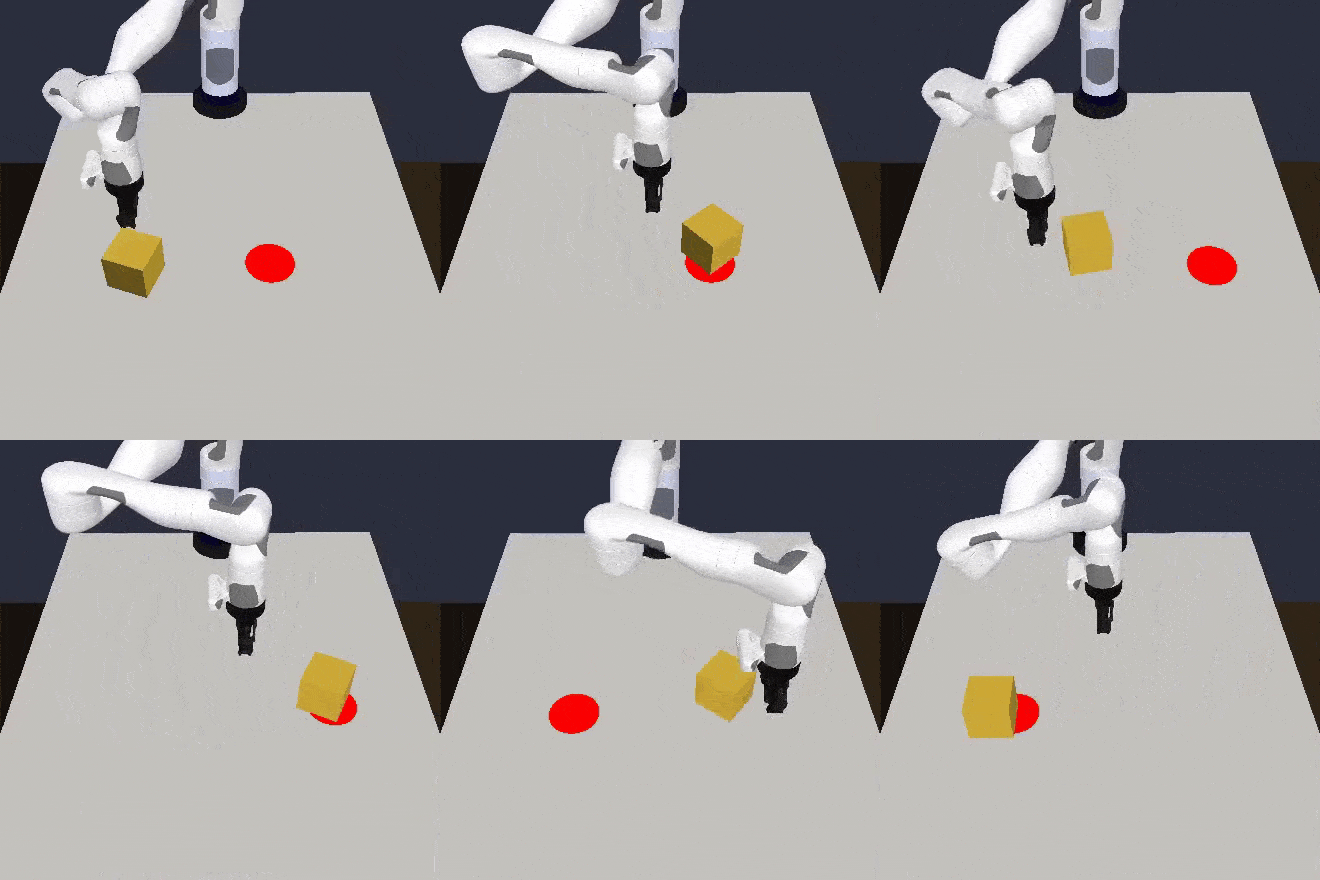
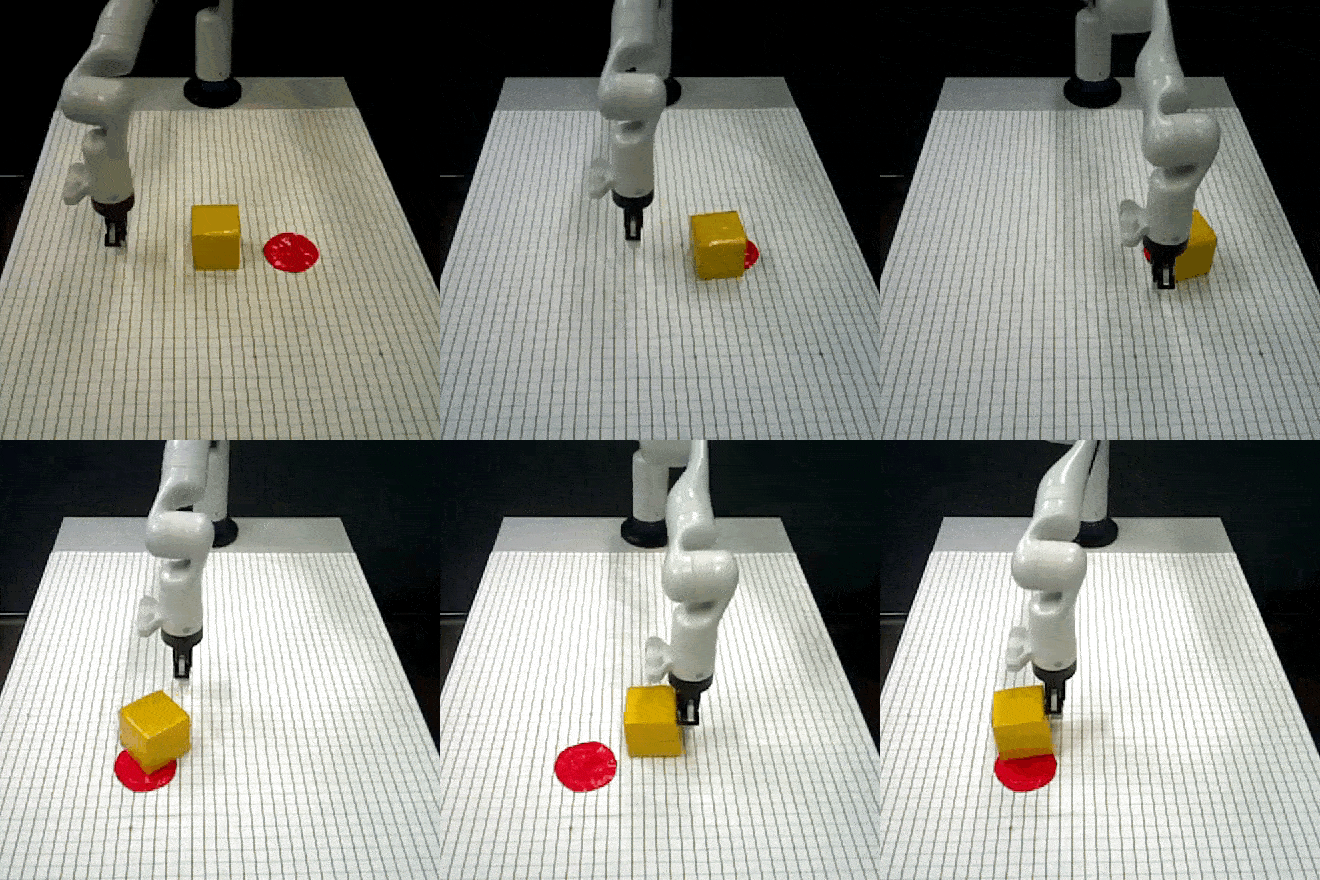
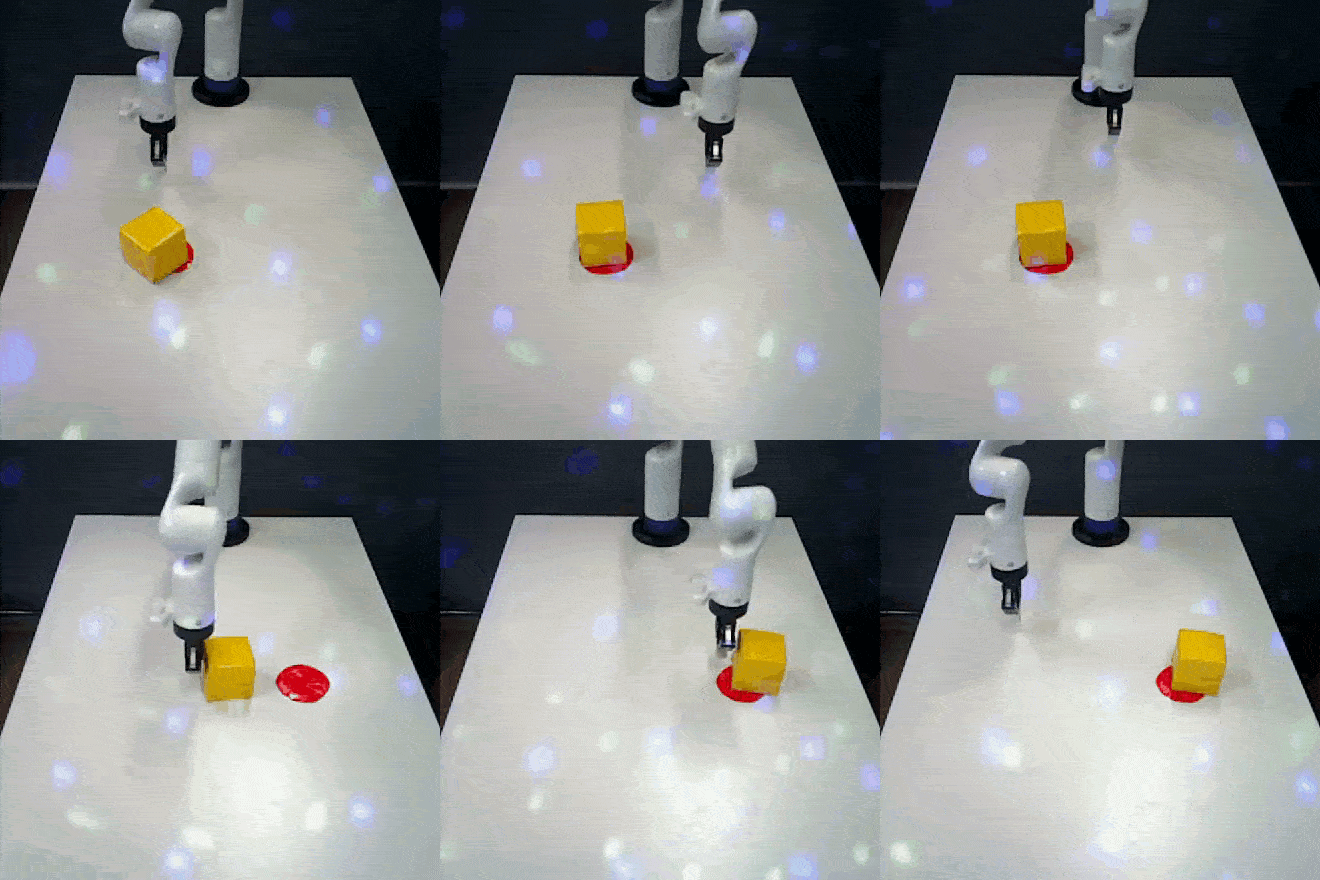
Our method learns a task in a fixed, simulated environment and quickly adapts
to new environments (e.g. the real world) solely from online interaction during
deployment.
The ability for humans to generalize their knowledge and experiences to new
situations is remarkable, yet poorly understood. For example, imagine a human
driver that has only ever driven around their city in clear weather. Even
though they never encountered true diversity in driving conditions, they have
acquired the fundamental skill of driving, and can adapt reasonably fast to
driving in neighboring cities, in rainy or windy weather, or even driving a
different car, without much practice nor additional driver’s lessons. While
humans excel at adaptation, building intelligent systems with common-sense
knowledge and the ability to quickly adapt to new situations is a long-standing
problem in artificial intelligence.
Continue
The Successor Representation, Gamma-Models, and Infinite-Horizon Prediction
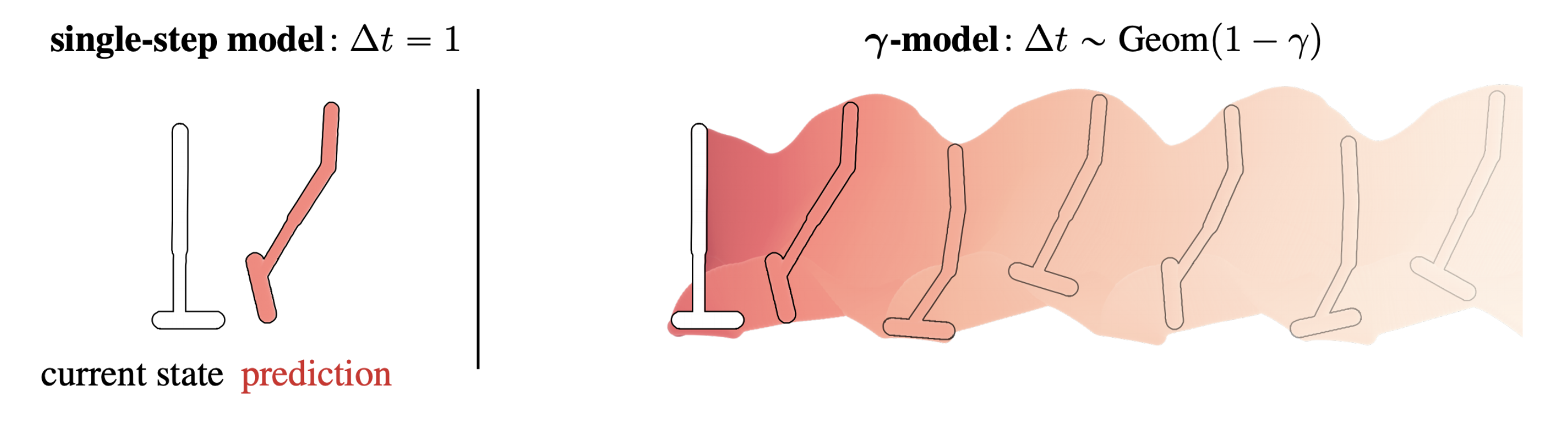
Standard single-step models have a horizon of one. This post describes a method for training predictive dynamics models in continuous state spaces with an infinite, probabilistic horizon.
Reinforcement learning algorithms are frequently categorized by whether they predict future states at any point in their decision-making process. Those that do are called model-based, and those that do not are dubbed model-free. This classification is so common that we mostly take it for granted these days; I am guilty of using it myself. However, this distinction is not as clear-cut as it may initially seem.
In this post, I will talk about an alternative view that emphases the mechanism of prediction instead of the content of prediction. This shift in focus brings into relief a space between model-based and model-free methods that contains exciting directions for reinforcement learning. The first half of this post describes some of the classic tools in this space, including
generalized value functions and the successor representation. The latter half is based on our recent paper about infinite-horizon predictive models, for which code is available here.
Continue
Most likely not.
Yet, OpenAI’s GPT-2 language model does know how to reach a certain Peter W--- (name redacted for privacy). When prompted with a short snippet of Internet text, the model accurately generates Peter’s contact information, including his work address, email, phone, and fax:
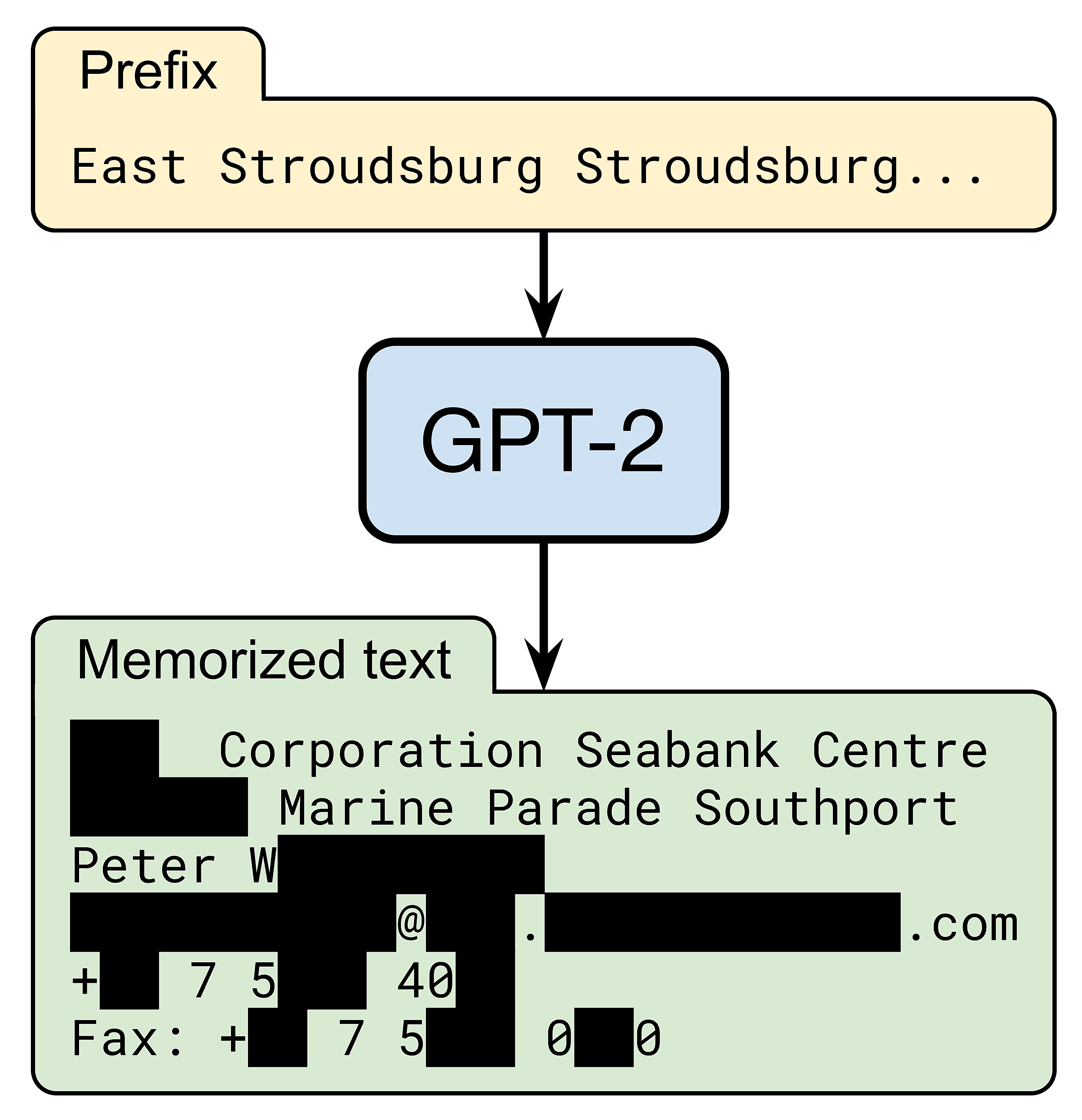
In our recent paper, we evaluate how large language models memorize and regurgitate such rare snippets of their training data. We focus on GPT-2 and find that at least 0.1% of its text generations (a very conservative estimate) contain long verbatim strings that are “copy-pasted” from a document in its training set.
Such memorization would be an obvious issue for language models that are trained on private data, e.g., on users’ emails, as the model might inadvertently output a user’s sensitive conversations. Yet, even for models that are trained on public data from the Web (e.g., GPT-2, GPT-3, T5, RoBERTa, TuringNLG), memorization of training data raises multiple challenging regulatory questions, ranging from misuse of personally identifiable information to copyright infringement.
Continue
Deep reinforcement learning has made significant progress in the last few years, with success stories in robotic control, game playing and science problems. While RL methods present a general paradigm where an agent learns from its own interaction with an environment, this requirement for “active” data collection is also a major hindrance in the application of RL methods to real-world problems, since active data collection is often expensive and potentially unsafe. An alternative “data-driven” paradigm of RL, referred to as offline RL (or batch RL) has recently regained popularity as a viable path towards effective real-world RL. As shown in the figure below, offline RL requires learning skills solely from previously collected datasets, without any active environment interaction. It provides a way to utilize previously collected datasets from a variety of sources, including human demonstrations, prior experiments, domain-specific solutions and even data from different but related problems, to build complex decision-making engines.

Continue
Many tasks that we do on a regular basis, such as navigating a city, cooking a
meal, or loading a dishwasher, require planning over extended periods of time.
Accomplishing these tasks may seem simple to us; however, reasoning over long
time horizons remains a major challenge for today’s Reinforcement Learning (RL)
algorithms. While unable to plan over long horizons, deep RL algorithms excel
at learning policies for short horizon tasks, such as robotic grasping,
directly from pixels. At the same time, classical planning methods such as
Dijkstra’s algorithm and A$^*$ search can plan over long time horizons, but
they require hand-specified or task-specific abstract representations of the
environment as input.
To achieve the best of both worlds, state-of-the-art visual navigation methods
have applied classical search methods to learned graphs. In particular, SPTM [2]
and SoRB [3] use a replay buffer of observations as nodes in a graph and learn
a parametric distance function to draw edges in the graph. These methods have
been successfully applied to long-horizon simulated navigation tasks that were
too challenging for previous methods to solve.
Continue
Aldo Pacchiano, Jack Parker-Holder, Luke Metz, and Jakob Foerster
Nov 13, 2020
Goodhart’s Law is an adage which states the following:
“When a measure becomes a target, it ceases to be a good measure.”
This is particularly pertinent in machine learning, where the source of many of
our greatest achievements comes from optimizing a target in the form of a loss
function. The most prominent way to do so is with stochastic gradient descent
(SGD), which applies a simple rule, follow the gradient:
\[\theta_{t+1} = \theta_t - \alpha \nabla_\theta \mathcal{L}(\theta_t)\]
For some step size $\alpha$. Updates of this form have led to a series of
breakthroughs from computer vision to reinforcement learning, and it is easy to
see why it is so popular: 1) it is relatively cheap to compute using backprop
2) it is guaranteed to locally reduce the loss at every step and finally 3) it
has an amazing track record empirically.
Continue
Imagine that you are building the next generation machine learning model for handwriting transcription. Based on previous iterations of your product, you have identified a key challenge for this rollout: after deployment, new end users often have different and unseen handwriting styles, leading to distribution shift. One solution for this challenge is to learn an adaptive model that can specialize and adjust to each user’s handwriting style over time. This solution seems promising, but it must be balanced against concerns about ease of use: requiring users to provide feedback to the model may be cumbersome and hinder adoption. Is it possible instead to learn a model that can adapt to new users without labels?
Continue