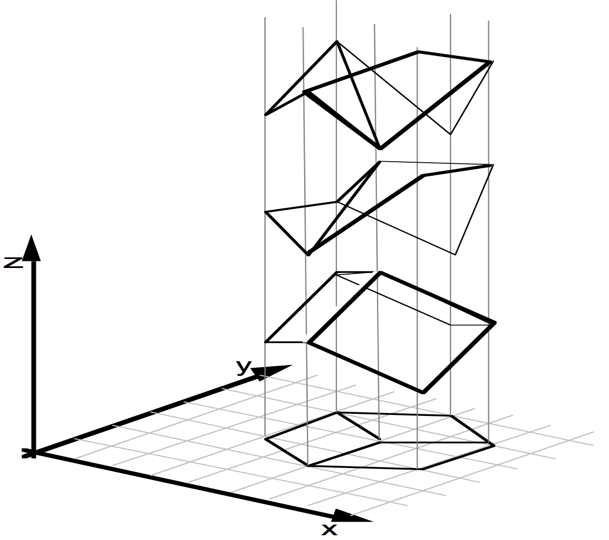
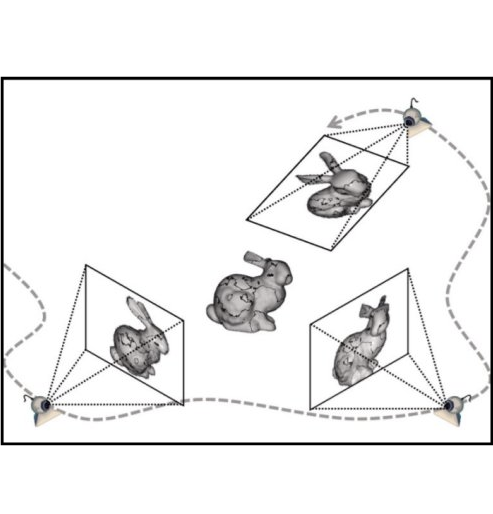
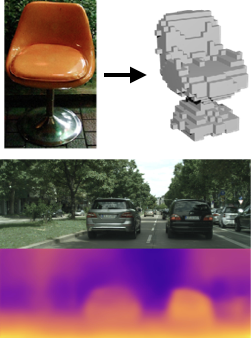
Given only a single 2D image, humans are able to effortlessly infer the rich 3D structure of the underlying scene. Since inferring 3D from 2D is an ambiguous task by itself (see e.g. the left figure below), we must rely on learning from our past visual experiences. These visual experiences solely consist of 2D projections (as received on the retina) of the 3D world. Therefore, the learning signal for our 3D perception capability likely comes from making consistent connections among different perspectives of the world that only capture partial evidence of the 3D reality. We present methods for building 3D prediction systems that can learn in a similar manner.
An image could be the projection of infinitely many 3D structures (figure from Sinha & Adelson).
Our visual experiences solely comprise of 2D projections of the 3D world.
Our approach can learn from 2D projections and predict shape (top) or depth (bottom) from a single image.
Building computational models for single image 3D inference is a long-standing problem in computer vision. Early attempts, such as the Blocks World or 3D surface from line drawings, leveraged explicit reasoning over geometric cues to optimize for the 3D structure. Over the years, the incorporation of supervised learning allowed approaches to scale to more realistic settings and infer qualitative (e.g. Hoiem et al.) or quantitative (e.g. Saxena et al.) 3D representations. The trend of obtaining impressive results in realistic settings has since continued to the current CNN-based incarnations (e.g. Eigen & Fergus, Wang et al.), but at the cost of increasing reliance on direct 3D supervision, making this paradigm rather restrictive. It is costly and painstaking, if not impossible, to obtain such supervision at a large scale. Instead, akin to the human visual system, we want our computational systems to learn 3D prediction without requiring 3D supervision.
With this goal in mind, our work and several other recent approaches explore another form of supervision: multi-view observations, for learning single-view 3D. Interestingly, not only do these different works share the goal of incorporating multi-view supervision, the methodologies used also follow common principles. A unifying foundation to these approaches is the interaction between learning and geometry, where predictions made by the learning system are encouraged to be ‘geometrically consistent’ with the multi-view observations. Therefore, geometry acts as a bridge between the learning system and the multi-view training data.
We recently developed a principled way to incorporate safety requirements and other constraints directly into a family of state-of-the-art deep RL algorithms. Our approach, Constrained Policy Optimization (CPO), makes sure that the agent satisfies constraints at every step of the learning process. Specifically, we try to satisfy constraints on costs: the designer assigns a cost and a limit for each outcome that the agent should avoid, and the agent learns to keep all of its costs below their limits.
This kind of constrained RL approach has been around for a long time, and has even inspired closely-related work here at Berkeley on probabilistically safe policy transfer. But CPO is the first algorithm that makes it practical to apply deep RL to the constrained setting for general situations—and furthermore, it comes with theoretical performance guarantees.
In our paper, we describe an efficient way to run CPO, and we show that CPO can successfully train neural network agents to maximize reward while satisfying constraints in tasks with realistic robot simulations. If you want to try applying CPO to your constrained RL problem, we’ve open-sourced our code.
Reliable robot grasping across many objects is challenging due to sensor noise
and occlusions that lead to uncertainty about the precise shape, position, and
mass of objects. The Dexterity Network (Dex-Net) 2.0 is a project centered on
using physics-based models of robust robot grasping to generate massive datasets
of parallel-jaw grasps across thousands of 3D CAD object models. These datasets
are used to train deep neural networks to plan grasps from a point clouds on a
physical robot that can lift and transport a wide variety of objects.
To facilitate reproducibility and future research, this blog post announces the
release of the:
Dexterity Network (Dex-Net) 2.0 dataset: 6.7 million pairs of synthetic point clouds and grasps with robustness labels. [link to data folder]
Grasp Quality CNN (GQ-CNN) model: 18 million parameters trained on the Dex-Net 2.0 dataset. [link to our models]
GQ-CNN Python Package: Code to replicate our GQ-CNN training results on synthetic data (note System Requirements below). [link to code].
In the post, we also summarize the methods behind Dex-Net 2.0 (1), our
experimental results on a real robot, and details on the datasets, models, and
code.
(Joint work with Ronghang Hu, Marcus Rohrbach, Trevor Darrell, Dan Klein and
Kate Saenko.)
Suppose we’re building a household robot, and want it to be able to answer
questions about its surroundings. We might ask questions like these:
How can we ensure that the robot can answer these questions correctly? The
standard approach in deep learning is to collect a large dataset of questions,
images, and answers, and train a single neural network to map directly from
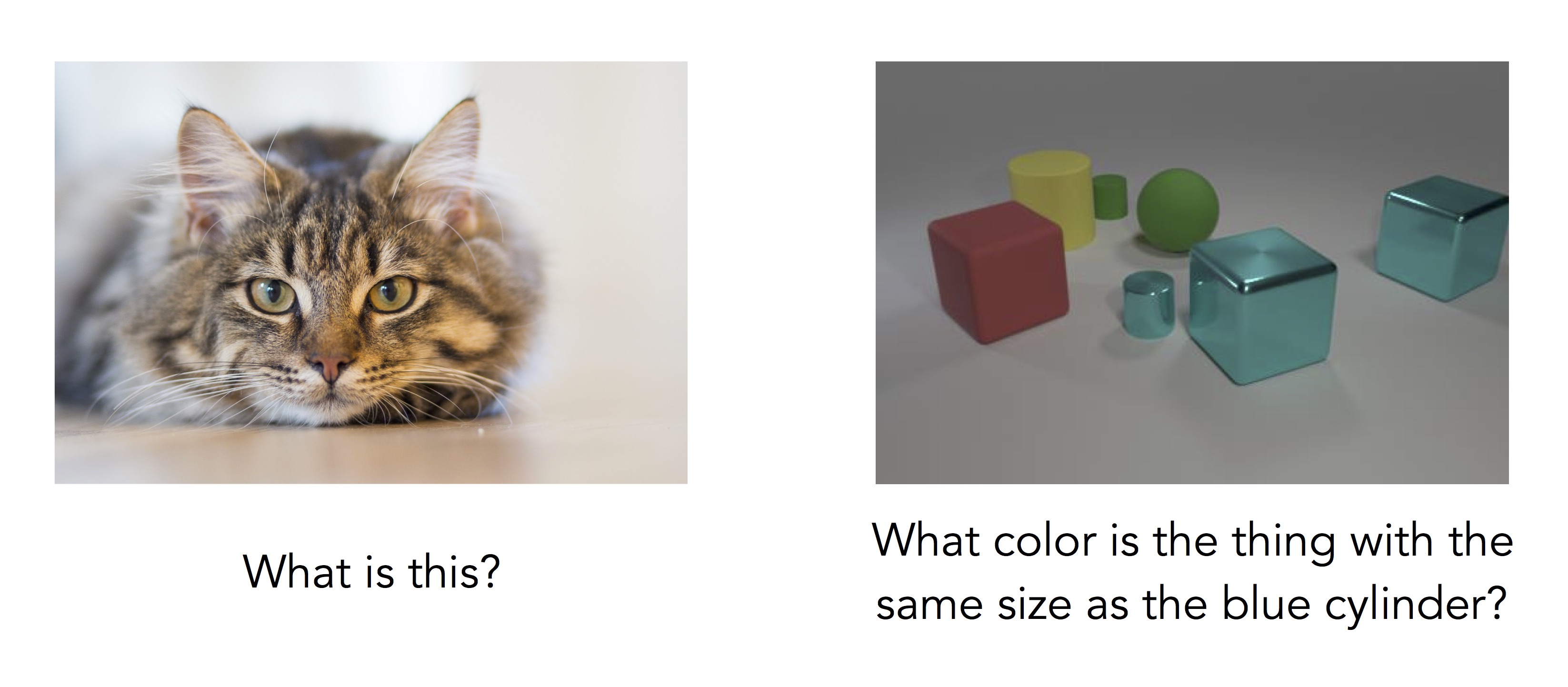
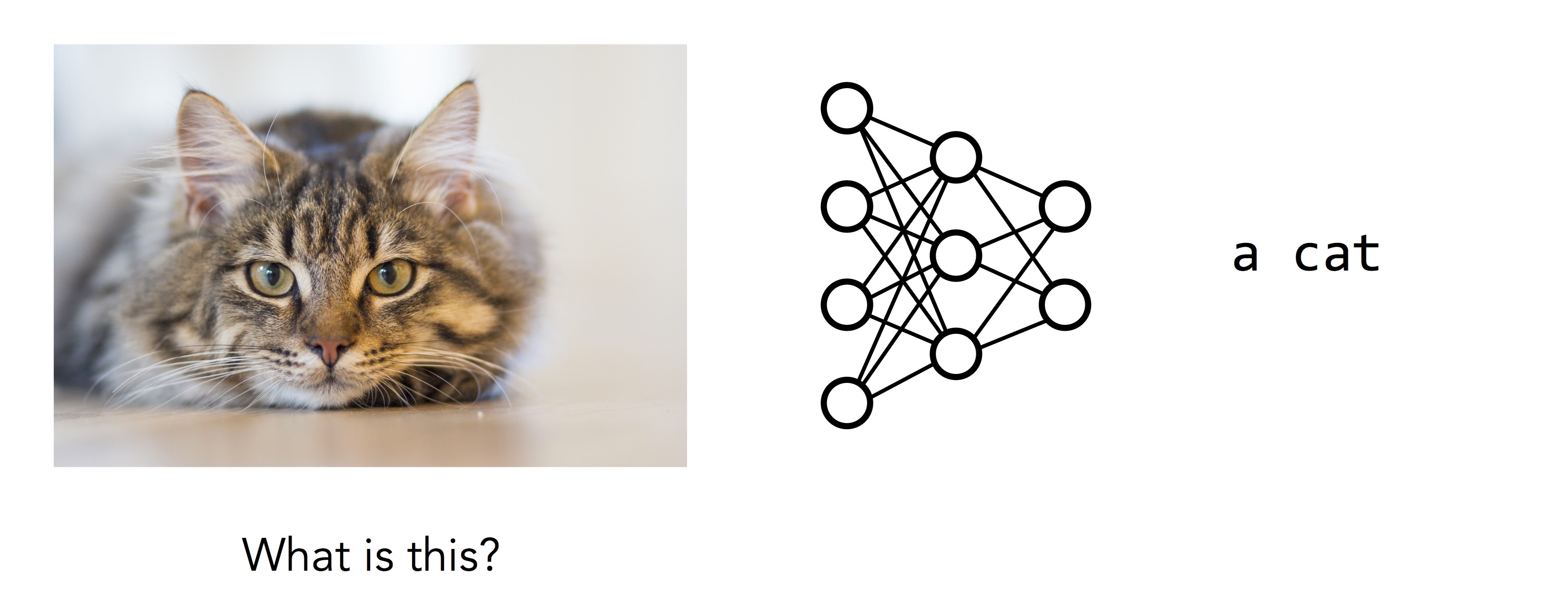
questions and images to answers. If most questions look like the one on the
left, we have a familiar image recognition problem, and these kinds of
monolithic approaches are quite effective:
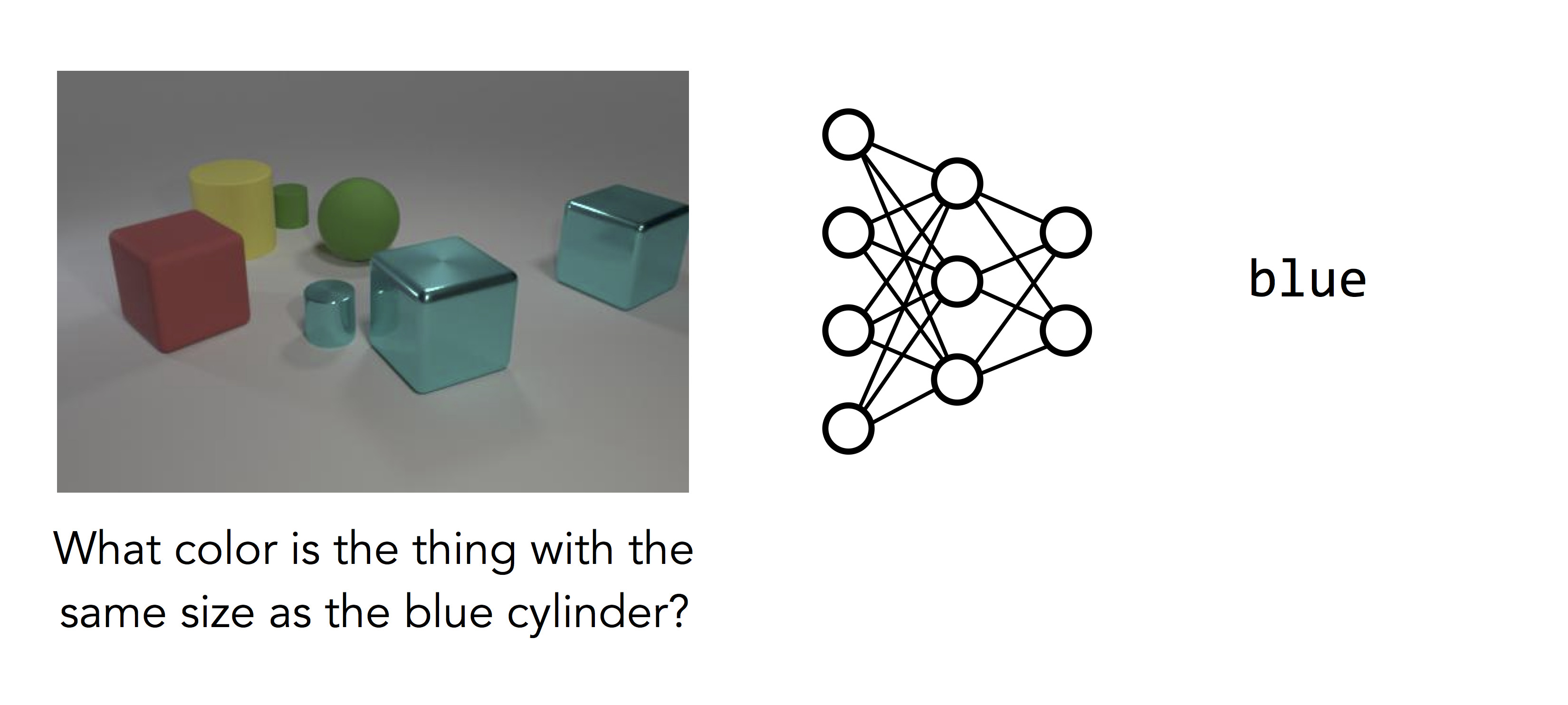
But things don’t work quite so well for questions like the one on the
right:
Here the network we trained has given up and guessed the most common color in
the image. What makes this question so much harder? Even though the image is
cleaner, the question requires many steps of reasoning: rather than
simply recognizing the main object in the image, the model must first find the
blue cylinder, locate the other object with the same size, and then determine
its color. This is a complicated computation, and it’s a computation
specific to the question that was asked. Different questions require
different sequences of steps to solve.
The dominant paradigm in deep learning is a "one size fits all" approach: for
whatever problem we’re trying to solve, we write down a fixed model architecture
that we hope can capture everything about the relationship between the input and
output, and learn parameters for that fixed model from labeled training
data.
But real-world reasoning doesn’t work this way: it involves a variety of
different capabilities, combined and synthesized in new ways for every new
challenge we encounter in the wild. What we need is a model that can
dynamically determine how to reason about the problem in front of it—a
network that can choose its own structure on the fly. In this post, we’ll talk
about a new class of models we call neural module networks
(NMNs), which incorporate this more flexible approach to problem-solving while
preserving the expressive power that makes deep learning so effective.
Berkeley AI Research (BAIR) brings together researchers at UC Berkeley across
the areas of computer vision, machine learning, natural language processing,
planning, and robotics, and each year we publish cutting edge research across
all of these areas. Dissemination of scientific results is a core component of
our mission, and while the traditional avenues for fulfilling this mission –
publications and presentations at academic conferences – continue to be the
primary method for disseminating our results, we must also strive to make our
results accessible, easily interpretable, and available to all. As part of this
effort, we are launching the BAIR Blog, a general audience blog where we will
present and discuss recent results in computer vision, deep learning, robotics,
NLP, and a variety of other areas where BAIR conducts cutting-edge research. Our
aim with the BAIR Blog will be to present recent scientific findings in a format
that is engaging, accessible, but at the same time informative for readers with
all levels of expertise. Our inaugural post describes some recent work at BAIR
at the intersection of vision and natural language processing. Posts on a
variety of other topics will follow on a weekly basis.